When and How to Use the 4 Elements
1 September 2026
In my last blog entry, I discussed the principles of the 4 Elements System (4ES – like a tax return form…). Here, I will elaborate on the different ways you should use the 4ES, depending on the stage you are at in your learning of the piece. I am going to go through the first three stages of the 4ES; the last one, the performance stage, needs a whole entry by itself.
But before we delve into this: if you are just beginning to play the chosen piece, the first thing you should do is Listen!
Yes! With a capital L and an exclamation mark.
You should listen to at least three different performances of the piece, if not more, and I don't mean casual listening. You should be sitting with the music open and a pencil in your hand. Mark places of interest, mark pauses that are not written in the notes, mark different fingerings (Oh, she is playing that in the D string…). Note that fingerings and bowings are not set in stone and you have a lot of room to maneuver.
Now to business: So many students believe in "playing under tempo" for several weeks throughout the piece, accelerating only once they learn the notes. I feel this is a very wasteful and not productive way. Many of the fingerings and bow techniques are greatly influenced by the speed you play and your musical approach. Playing slowly is commendable and should be done, but you should speed up as soon as possible, and I mean on the first practice session.
Another issue worth mentioning here is that our minds memorize best through short actions. If you need to learn a poem by heart, you would not just read the poem through. You most likely repeat the first line several times, then go to the next line. Same for practicing.
Take the first line or phrase you want to learn and go through the entire 4ES on that line alone.
Let's imagine you want to practice Beethoven's Violin Concerto, or Mendelssohn's.
The Technique Stage
After listening and having an idea of how the piece is supposed to be heard, we go to work:
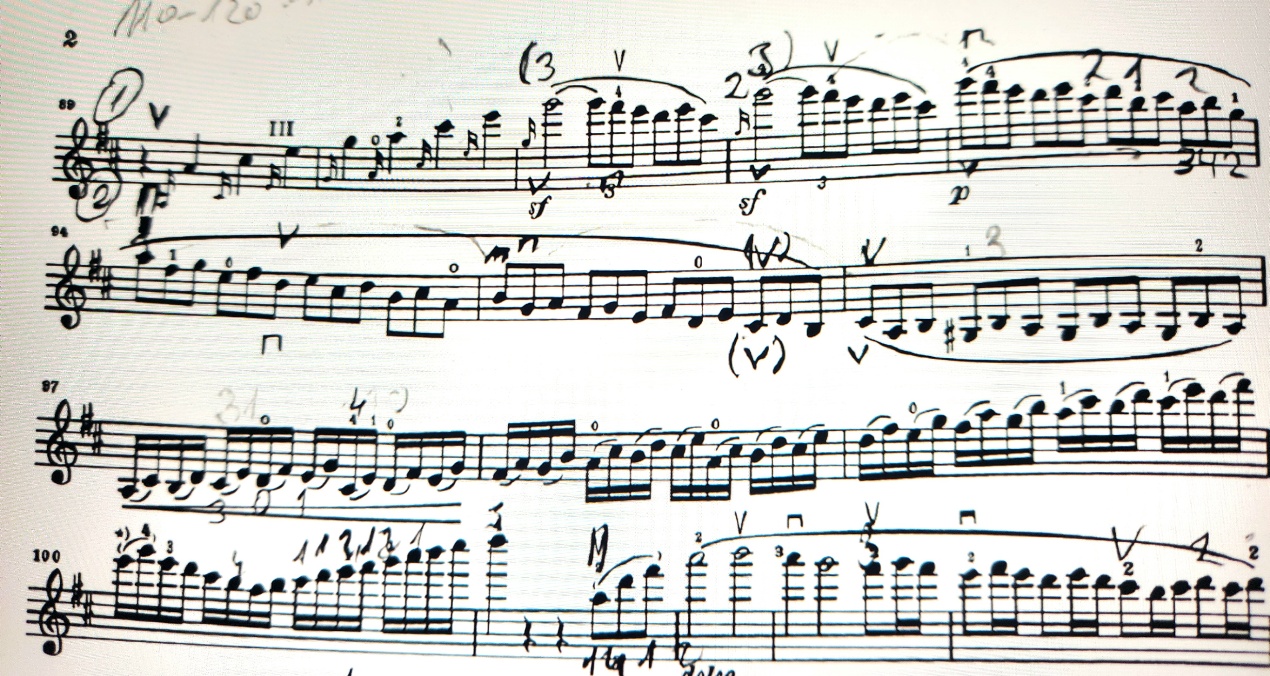
On the Technique stage, you should work the octaves carefully for intonation, both together and separately, and on the shift from each octave to the next. The next phrase is trickier; you should decide on the right fingerings and where to cut the bow. Again, separate notes are fine, but go to slow staccato for bow space allocation, or 2/3/4 notes slurred, but keep the directions and bow cuts you chose. You should be able to play everything at the right speed by the end of this stage.
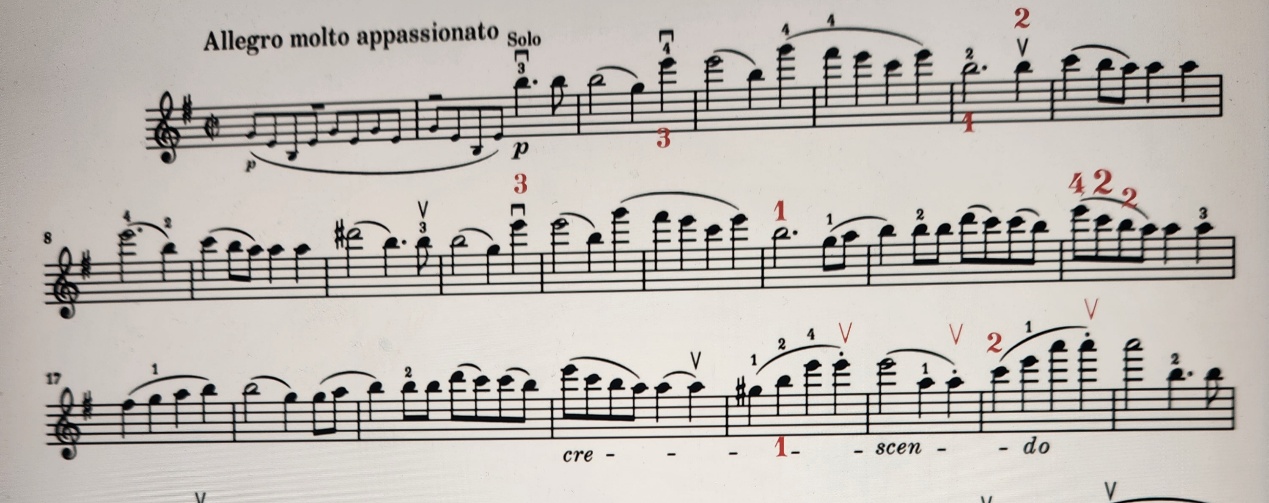
Mendelssohn's beginning is a little less technical, but essentially the same way. You work either by phrase or throughout the opening "paragraph" (around three lines), figure out the notes, and work your shifts carefully, then get everything up to speed.
The Sound Stage
Stage 2 is working on the element of Sound. Remember, if all is well, you are still in your first practice session. Vibrato and bow control are what make your sound. Pick one feature and work on it. For vibrato on Beethoven, work on the top of each octave, taking time to vibrate. Bow control is much trickier here: on the octaves, you must control your bow length, how you cut the octave itself, and the dynamic progression. The triplets need to be addressed with bow division. Everything must sound Good! (Again, with a capital G).
By comparison, the opening of Mendelssohn's concerto has more vibrato moments to work on. You could decide on the intensity of both left and right hands and the sound you want to produce.
The Musicianship Stage
The third stage, the Musicianship element, is sort of tricky. On one hand, everything is musical; every bowing, fingering, and tempo decision is, first and foremost, a musical decision. So logically, your first two stages, the Technique and Sound elements, should already take musicality into account. But that usually does not happen. The sheer concentration on technicalities, the need to play slowly and quickly work up to speed, the concentration on bow and sound controls – all of these are kind of musicality "killers."
This stage is important to re-ignite the flame of inspiration. Firstly, you need to make sure you are actually doing what you set out to do. Are you strewing the right notes in the right way? Are you doing this clearly enough for others to hear and understand your intent? This is also the stage to experiment a little, play a little slower or a little faster, accentuate other notes (within reason, please…), maybe even try a completely opposite musical agenda, just to practice what needs to be done to make a phrase sound different.
Going back to the Beethoven Concerto: the octave arpeggios are quite straightforward, but you could play them rigidly in tempo, slow down at the end, or start hesitantly. The triplets that come next need a decision on when to change bows: on the beginning of the bar, off the beginning of the bar, or (my personal favorite) changing when there is a string change, thus keeping continuity.
The Mendelssohn's Concerto is too complex, with too many musical possibilities, to describe here. Suffice to say, you can play the beginning in several distinctively different ways.
In my next entry, I'll discuss the Performance stage.